KENDAL FITZHUGH
Music and Black art have always grounded me. When stress unravels me, certain songs bring me back, and I can literally feel myself returning to Earth, calmer. That feeling is not small. It is liberation.
But traditional protest has limits. Walkouts, sit-ins, and marches are essential, but they are not the only language of revolution. The Black Arts Movement taught us otherwise. As Larry Neal writes, “Black Art is the aesthetic and spiritual sister of the Black Power concept.” This collage argues that art itself, not just as accompaniment to protest but as its own form of action, can be a beautiful, affective site of liberatory community.
I built a visual gradient moving away from conventional protest symbols and into the arts. The megaphone sits at one edge; the earth sits beside it. Both are drawn by hand, grounding the conversation in the familiar. But taped over them are magazine clippings—ripped, reshaped, pasted down. This contrast between drawn base and cut pieces mirrors John Corbett’s argument in Extended Play about accessing “the insane.” Where the expected location is Earth (marches, slogans), we are so much more. Taking something that already exists—a magazine, a struggle, a history—and reshaping it into something greater is itself a liberatory act.
The Last Angel of History documentary directed by John Akomfrah asks how we access our ancestors’ lives to continue their work. We have technology whereas they did not and therefore can access their lives in ways that past generations could not. This collage creates space for others to tap into that feeling, peace, motivation, community, reassurance—not by abandoning protest, but by expanding what we count as revolutionary. Art is a language anyone can understand. That is its power.
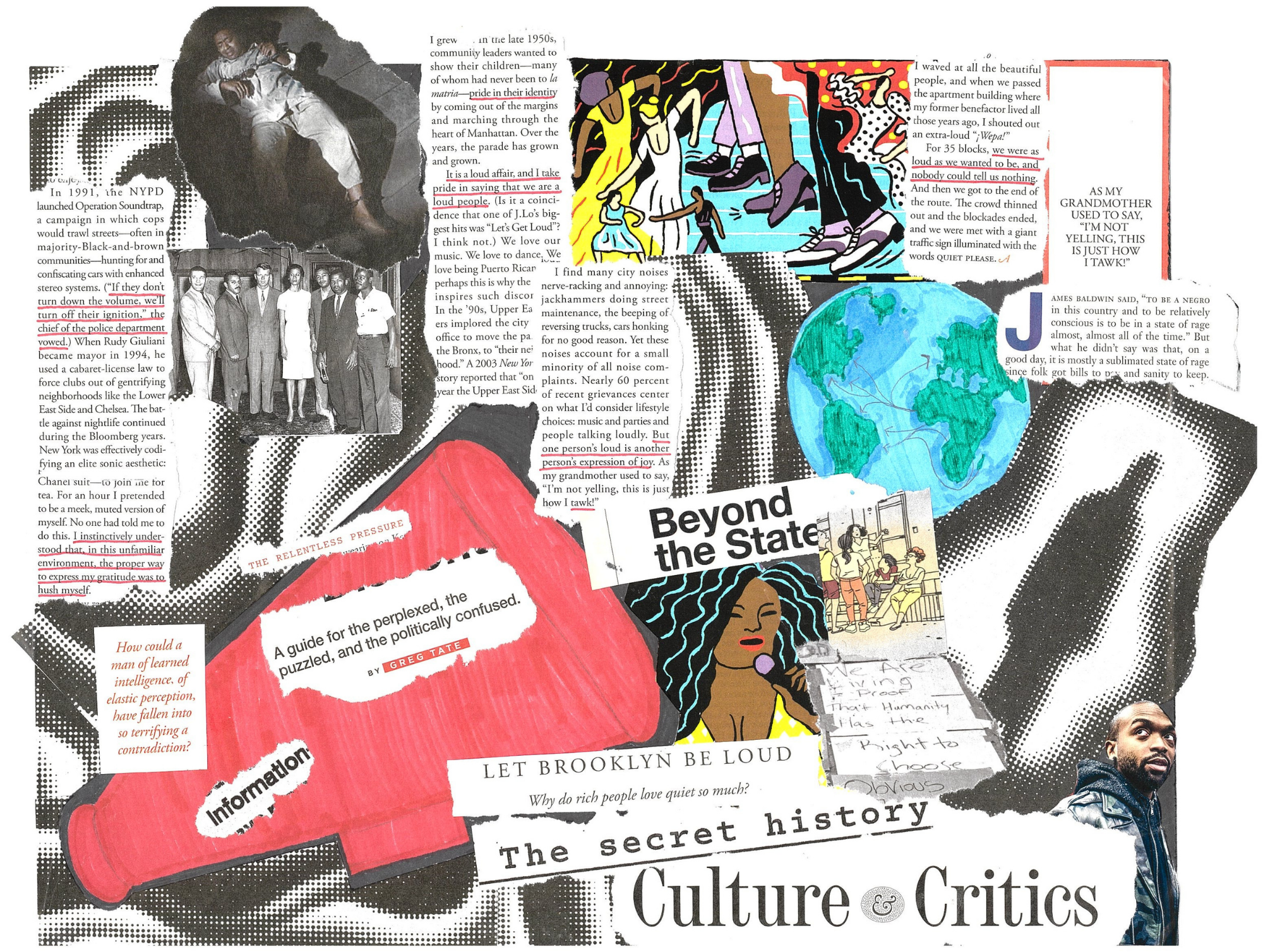
Untitled, 2026
11.5 × 14.5 in.
Magazine clippings, marker, and pencil on paper
Sources in Conversation
Academy of American Poets, “A Brief Guide to the Black Arts Movement,” 2014.
John Corbett, “Brothers from Another Planet: The Space Madness of Lee ‘Scratch’ Perry, Sun Ra, and George Clinton,” in Extended Play: Sounding Off From John Cage to Dr. Funkenstein (Duke University Press, 1994).
John Akomfrah, dir., The Last Angel of History, 1996.