JUSTIN KINNISON
In my anger toward racism, I used to think in opposition to Eurocentrism, like many Afrocentrists, accepting its terms. However, I have discovered that detachment from this discourse is the only way to gain liberation. Detachment explores the concept through a demonstration of intellectual chaos and other-worldly, insanity-enabled transcendence through three sources assigned in this course.
Firstly, We Can’t Go Home Again by Clarence Walker inspires the tape connecting the countries, representing the concepts “unanimism” and “essentialism”—Afrocentrists viewing Africa as one entity, ignoring the diverse cultures present. The white superheroes represent the white scholars, whose work and culture were viewed as the paradigm. The fire and the tree represent their ideas: some Eurocentric and negative, others positive. However, both of these kinds of ideas were turned into damaging concepts, such as Edward Wilmot Blyden’s “African personality,” which is rejected by the American flag with a black woman on it, showing that black Americans are “Made in America.” The fire comes from white and black scholars from Western-influenced cultures, represented by the American flag. A pencil is crossing out all countries except for Egypt and shining a light onto Egypt, which contains a QR code to the entirety of Africa. This demonstrates the glorification of Egypt as a description of all of Africa, as well as the marginalization of the rest of Africa. The big peace sign with the black woman represents the spiritual-materialistic dichotomy.
Virginia Hamilton’s “The People Could Fly” is symbolized in the collage by the golden borders, which represent cultural diversity. This diversity is explored through the fact that some people had access to magic, a rejection of unanimism. This source is also represented by the rocket ships flying away.
George Clinton’s song “Computer Games” ties everything together. He and the images of insanity are on the outskirts, detached from the chaos, escaping the confining ideas of Eurocentrism and Afrocentrism through his insanity. The foil background represents how, when you detach, you can see yourself for who you truly are. This is the main argument of my piece: that opposition to racism is chaotic when stepping into Eurocentrism and liberatory when centering detachment.
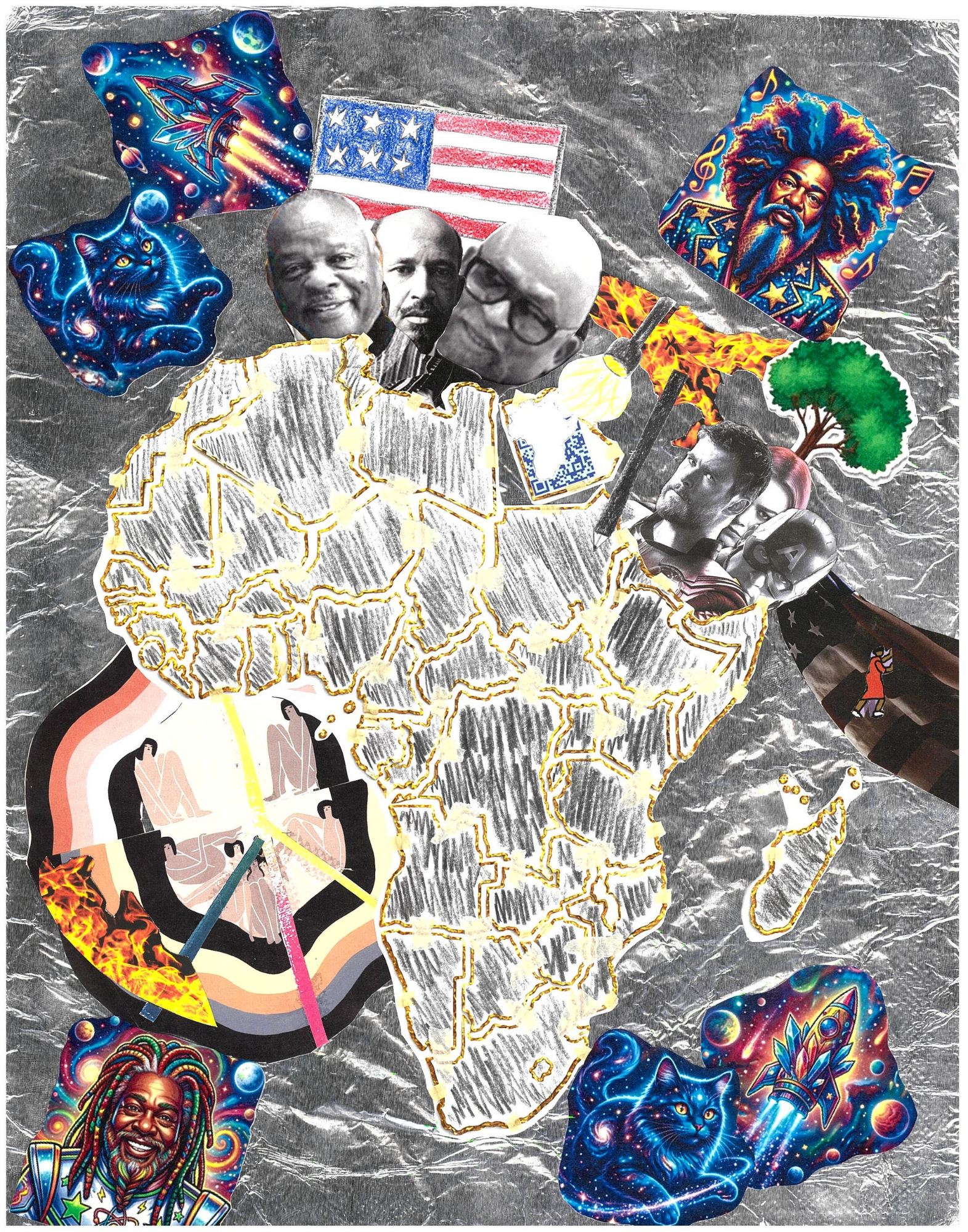
Detachment, 2026
14 × 11 in.
Magazine clippings, foil, AI-generated images printed on paper, masking tape, graphite, and colored pencil on paper
Sources in Conversation
Clarence E. Walker, We Can’t Go Home Again: An Argument About Afrocentrism (Oxford University Press, 2001).
Virginia Hamilton, “The People Could Fly,” in The People Could Fly: American Black Folktales (Alfred A. Knopf, 1985).
George Clinton, “Computer Games,” on Computer Games, 1982.