GRACE CALLWOOD
Throughout my academic journey, I have been drawn to concepts of identity, representation, and cultural meaning-making. In examining the conceptual grounds of “Europe Upside Down” by Kwame Anthony Appiah, “Brothers from Another Planet” by John Corbett, and “Come Back Pharaoh” by Amiri Baraka, central aspects of their socio-political commentary have surrounded Black identity, varying manifestations of identity, and cultural meaning making. Appiah’s prevailing commentary is that Afrocentrism is essentially Eurocentrism for Black people. Through my piece, Untitled, I am seeking meaning in the overlap within Eurocentric formatting of Black/Afrocentric messaging. This is represented by the stiffness and professionalism of fonts included in the collage that read “Black in America” and “Ancestor Worship,” and the side profile, presumably of a white male, used to convey internationalism and diasporic unity. My aim is to reject Afrocentrism as the counter to Eurocentrism and instead accept it as a strain of universalism.
Corbett highlights the connection between diasporic history and extraterrestriality, cultural production, space iconography, the innovation of technology in music, and the blurred lines between outer space and Earth. My collage displays music and history as vehicles of space and time travel for Black people across the diaspora. This is primarily shown through the image of the Black man with braids on the turntables, the Black person holding a guitar, and the multiple images of outer space throughout. These images work together as a conglomeration of visual incantations to Black innovation and otherness. Baraka takes on the charge of exploring ideas of madness, the afterworld/other worlds, the universe, the spirit, and the strife of Black life in America through polyrhythms and spoken word. In my work, I aimed to address such themes in the exploration of time, space, and being, and the centering power that music has in the Black community. This is represented by the image of the DNA strand with a person listening to music in the center, the flower fading into digital specks, the imagery of outer space, and the words “Mapping the Black Travel Renaissance.”
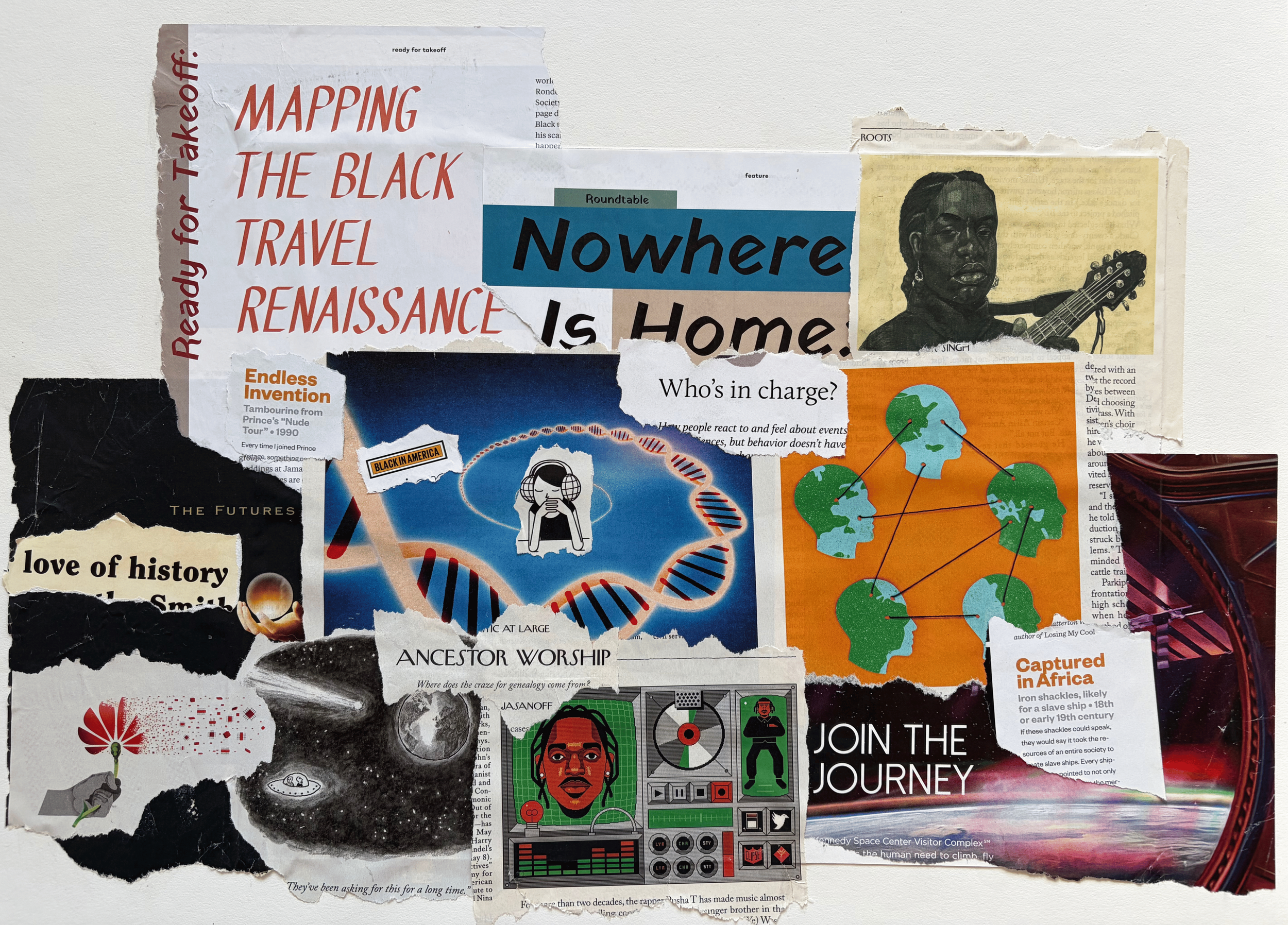
Untitled, 2026
14.25 × 19 in.
Magazine clippings on paper
Sources in Conversation
Kwame Anthony Appiah, “Europe Upside Down: Fallacies of the New Afrocentrism,” reprinted in Perspectives on Africa: A Reader in Culture, History and Representation, 2nd. edition (Wiley, 2010).
John Corbett, “Brothers from Another Planet: The Space Madness of Lee ‘Scratch’ Perry, Sun Ra, and George Clinton,” in Extended Play: Sounding Off From John Cage to Dr. Funkenstein (Duke University Press, 1994).
Amiri Baraka, “Come Back Pharaoh,” on It’s Nation Time: African Visionary Music, 1972.