DAVID GREEN
The goal of this piece is to encapsulate the selected sources in a way that presents a complete narrative of discursive struggle over Africa and within black political thought. The crux of my interpretation is to depict this process while granting recognition to and emphasizing the Marxist intellectual tradition. I chose these particular sources: “Africa on My Mind” by E. Frances White, John Henrik Clarke: A Great and Mighty Walk directed by St. Clair Bourne, and Amiri Baraka’s LP It’s Nation Time because I felt they would allow for a balanced composition.
The narrative being contained is one that highlights White’s framework of “discursive struggle” as a contest over the ideological sign of Africa. The composition is intended to depict the dominant discourse and counter discourse positions and their interrelation, while also including the internal critique of cultural nationalism, which is part of the essence of White’s work. The most direct correlation between the collage and White’s critique is the notion of the invented African past and its implications for the Afrocentrist vision of a nation, articulated within the Egyptian iconography.
It is the content of the collage that primarily evokes the work of Baraka and the commentary of Dr. John Henrik Clarke captured by the film. These two sources are closely related in the piece. On the one hand, the positions of civilizationism and cultural nationalism are subsumed into the visual representations of black life and city skylines. These works also most prominently influence the depiction of tension between cultural nationalism and socialism. Baraka and Dr. Clarke are clear in their respective works about their aversion to socialism and the belief that it is fundamentally un-African; this, alongside White’s critique, which is situated within a dialectical materialist framework, prompted me to address the red elephant in the room, so to speak.
It is the inclusion of these elements depicting Marxist thinkers and popular figures, which reframes White’s critique, or rather situates it in the context from which she is drawing her framework. In this way, my own interpretation is instilled into the work, which is the notion that within this lineage of Marxism, there is, in fact, a complete vision for the future of black people, one which contributors within black political thought accepted and advanced in distinction to cultural nationalism.
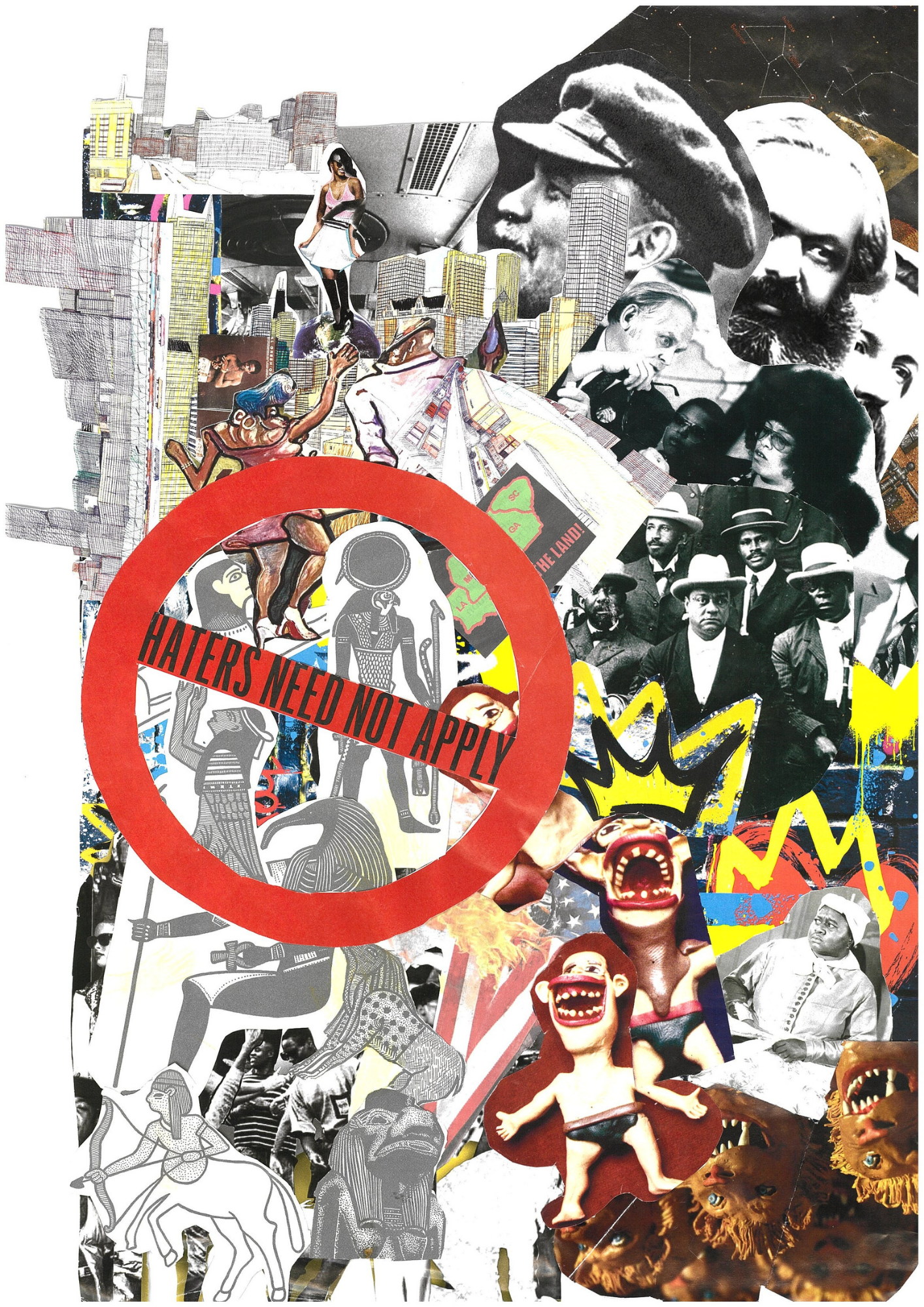
He Love Marx, 2026
16.5 × 12 in.
Magazine clippings on paper
Sources in Conversation
E. Frances White, “Africa on My Mind: Gender, Counter Discourse, and African American Nationalism,” reprinted in Is It Nation Time? Contemporary Essays on Black Power and Black Nationalism (University of Chicago Press, 2002) [originally published 1990].
St. Clair Bourne, dir., John Henrik Clarke: A Great and Mighty Walk, 1996.
Amiri Baraka, It’s Nation Time: African Visionary Music, 1972.