ALAIJAH SIMS
Before engaging with the material of this course, I thought that the debate over ancient Egypt’s racial identity was a recent controversy. I assumed Afrocentric scholars sought historical recognition and professional Egyptologists were defending academic standards. What I did not understand was the deep historical context of this debate. Scott Trafton’s chapter in Egypt Land reveals the racial contestation over ancient Egypt historically and the nineteenth-century American culture that thinkers on both sides used for opposing political purposes long before Afrocentrism existed as a named movement. The realization that the fight over ancient Egypt’s identity is not a recent dispute but a centuries-long wound is the foundation of my collage.
The three sources I selected work together to show that this wound did not produce a straightforward conflict between truth and politics, but rather a situation in which both sides of the debate have been shaped by the same historical erasure. Trafton explains where the contestation began. Donald Malcolm Reid shows how racial anxiety became institutionalized inside professional Egyptology between 1890 and 1960, distorting which periods were displayed and which faces were photographed. Ann Macy Roth completes the argument by demonstrating that honest engagement with ancient Egypt’s identity requires accountability from the discipline itself. Together, these sources reframed my understanding of knowledge production and ask the question of who controls the archive, and who gets written out of it.
What my collage tries to make visible is the tensions at the heart of all three sources: that ancient Egypt’s identity has been pulled in competing direction by forces whose contest predates the modern Afrocentric movement by centuries. The two hands reaching toward the center of the collage represent that pull, and the chaotic middle ground between them represents what Reid and Roth both acknowledge: that the fight over ancient Egypt remains distorted and resolution requires honesty from both sides.
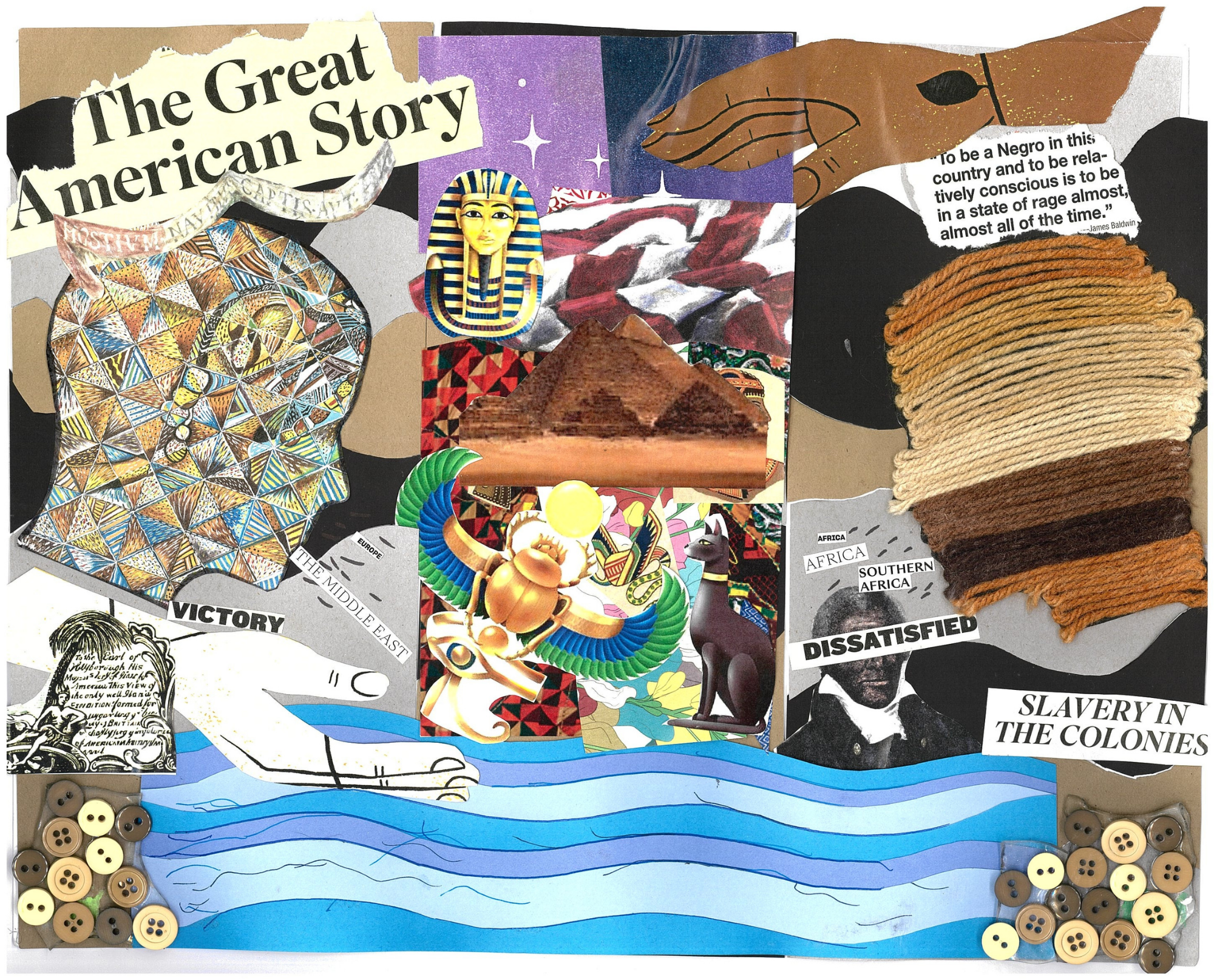
Untitled, 2026
11.5 × 14 in.
Magazine clippings, construction paper, digital images printed on paper, yarn, buttons, and ink on paper
Sources in Conversation
Scott Trafton, “‘A Veritable He-Nigger after All’: Egypt, Ethnology, and the Crises of History,” in Egypt Land: Race and Nineteenth-Century American Egyptomania (Duke University Press, 2004).
Donald Malcolm Reid, “Anxieties about Race in Egyptology and Egyptomania, 1890–1960,” Peabody Museum of Archeology & Ethnology and Harvard Semitic Museum, April 6, 2017.
Ann Macy Roth, “Building Bridges to Afrocentrism: A Letter to My Egyptological Colleagues,” American Research Center in Egypt Newsletter, no. 167 (September 1995): 1, 14–17; no. 168 (December 1995): 1, 12–15.